The newly released Department of Justice files offered a deeper glimpse into the hidden machinery surrounding Jeffrey Epstein and the ways he may have drawn victims into his orbit. Investigators and journalists who combed through the documents began to notice a pattern—one that intersected with the glamorous, international world of fashion modeling.
At first glance, the modeling industry looked exactly the way most people imagined it: polished runways in New York, casting calls in Miami, glossy magazine spreads, and the promise of a life transformed overnight. But behind the lights and cameras, the files suggested something far darker. According to allegations echoed across multiple civil lawsuits and investigative reports, modeling opportunities may have been used as a gateway—an entry point that allowed young women from around the world to be introduced to Epstein and the network around him.
The accusations described a system that appeared to rely on influence, money, and connections. Epstein was widely known in elite circles as a wealthy financier, someone who moved comfortably among billionaires and corporate power brokers. For nearly two decades, one of his most prominent associates was Leslie Wexner, the founder of L Brands, the company behind retail giants such as Victoria’s Secret and Bath & Body Works.
Epstein’s role in Wexner’s financial affairs went far beyond what most people expected from a financial adviser. Legal documents later revealed that Epstein held power of attorney over significant portions of Wexner’s finances and assets, including real estate and even a private plane. The relationship granted him extraordinary authority—an arrangement that would later raise many questions once Epstein’s criminal conduct became public.

A 2019 investigation by The New York Times described an incident that illustrated how those connections could intersect with the modeling world. In 1997, Epstein allegedly posed as a talent scout connected to Victoria’s Secret. Under that pretense, he invited model Alicia Arden to meet him in a hotel room in Santa Monica. According to the report, the meeting quickly turned uncomfortable. Arden later alleged that Epstein attempted to sexually assault her during the encounter.
By 2007, Wexner’s personal and business relationship with Epstein had come to an end. That period followed the first major wave of criminal allegations against Epstein involving minors. In 2008, he accepted a controversial plea deal in Florida, pleading guilty to charges related to solicitation of prostitution, including with a minor, while avoiding federal prosecution.
Around the same time, Wexner’s team reportedly discovered that Epstein had misappropriated large sums of family money. In a statement later issued through the Wexner Foundation, Wexner acknowledged that Epstein had taken substantial funds. Some of the money was eventually recovered, while other portions had been routed through charitable foundations that Epstein controlled.
Years later, in 2020, Wexner stepped down as chief executive of L Brands, transitioning into the role of chairman emeritus after declining sales at the company. Some observers speculated that the lingering shadow of his association with Epstein may have contributed to the company’s struggles, though no direct link was ever formally established.
Importantly, Wexner has consistently denied any knowledge of Epstein’s alleged sex trafficking activities. He has never been charged with a crime, and investigators have not produced concrete evidence showing that he knew what Epstein was doing.
Yet the documents suggested that Epstein’s connection to the modeling world extended far beyond that single relationship.
In the early 2000s, Epstein helped finance a modeling agency known as MC2 Model Management. The company had offices in New York and Miami and represented clients that included major department stores such as Nordstrom, Macy’s, Neiman Marcus, and Saks Fifth Avenue. The agency was founded by French model scout Jean‑Luc Brunel, a man who would later become one of the most controversial figures linked to Epstein.
Brunel was eventually accused in multiple civil suits of sexual abuse involving young models. While he denied the allegations, his name surfaced repeatedly in lawsuits and investigative reports connected to Epstein.
Newly surfaced court documents from a 2023 lawsuit between the U.S. Virgin Islands government and JPMorgan Chase revealed another financial link. According to those filings, the bank had approved a one‑million‑dollar standby letter of credit in Epstein’s name to support a loan to MC2 Model Management in 2005.
The agency’s business model relied heavily on international recruitment. Scouts traveled through Europe and other regions searching for young women who might succeed in fashion. For many aspiring models—especially those from smaller towns or modest backgrounds—the opportunity seemed like the chance of a lifetime.
But emails uncovered in the files painted a more complicated picture.
Many of those messages involved a Swedish model scout named Daniel Sead. Working under Brunel, Sead’s job was to search for potential models and connect them with the agency. His name appeared in the Epstein files hundreds—possibly thousands—of times.
One message from May 2016 came from Stan Pottinger, a lawyer representing several Epstein accusers. Writing to a New York prosecutor, Pottinger explained that Brunel had described Sead as a recruiter who helped locate girls and young women for Epstein.
The correspondence between Epstein and Sead stretched back years before that message.
In one exchange from 2009, Sead described his travels across Eastern Europe. He explained that he planned to spend weeks scouting small villages in Slovakia, the Czech Republic, Poland, and Hungary before the summer holidays. Traveling mostly by train and bus, he wrote that he sometimes had to take taxis and occasionally invite parents for lunch or coffee in order to gain their trust.
Sead estimated that the trip would cost at least four thousand euros. He mentioned that several girls were already waiting to meet him in Poland and Slovakia. In Kraków, he wrote, there were dozens of potential models to evaluate.
Epstein’s response was brief.
“How much?” he asked.
Sead replied with details of his travel expenses and described how he sometimes provided small amounts of money to the young women he met. He promised to send reports from each city and noted that he carried a camera that helped document his scouting work.
At one point he added a curious line, promising Epstein a “great surprise” the next time he visited Paris.
The meaning of that remark was never explained in the emails, but it raised questions among investigators reviewing the exchange.
Years later, another conversation appeared in the files. In a Skype message from 2016, Sead wrote that he was in Barcelona with an “amazing beauty.” He urged Epstein to call him back.
Epstein replied with a short question, asking for the Skype name and wondering whether the woman was “prettier and sweeter.”
Sead responded that she was indeed sweet but might not be suitable for the fashion industry.
“Call me,” Epstein replied.
In yet another message from 2017, Sead sent photographs of a woman he described as a “cute French girl” he had met in Marrakesh. He said she was twenty‑two years old and happy to meet Epstein.
Epstein responded with a single word.
“Cute.”
Two days later he wrote again: “All good.”
Sead suggested that Epstein visit Marrakesh later in the year. He said he could organize a casting session and arrange a private house for Epstein to stay in. If Epstein preferred a hotel, Sead added, he had connections at the Mandarin Oriental through a friend.
Epstein eventually replied that he might visit in late September when the weather was cooler.
Other messages focused directly on the ages of the women being recruited.
In a 2012 exchange, Sead sent photographs of a young woman he hoped to place with an agency in New York.
Epstein asked two questions.
“Have you seen her?”
“And how old is she?”
Sead answered that he spoke with her almost every day online. She was twenty years old, he said, and “very sweet and shy.”
Another exchange in 2014 was even more striking.
Epstein asked simply, “Age?”
Sead replied, “Twenty‑six, but she looks eighteen.”
While some of the women mentioned in the emails were adults, other messages appeared to reference teenagers. In one conversation from July 2014, Sead discussed several girls he had recruited from Sweden, Slovakia, France, Russia, and China. He described paying for plane tickets and hotel rooms while arranging meetings.
In the same message, he mentioned that at least five girls—ages sixteen and seventeen—might be ready for modeling work the following year. He also referred to a fifteen‑year‑old French girl whose parents had approved her plans to enter the industry.
Sead compared the process of finding talent to fishing.
“Sometimes you catch quickly,” he wrote. “Sometimes no fish.”
The language struck many readers as unsettling, particularly given the allegations surrounding Epstein and Brunel.
Another message from 2011 showed Sead presenting a potential recruit named Jessica, a nineteen‑year‑old woman of French and Berber heritage. He included her measurements and described her as a “very nice girl.”
Epstein’s response was blunt.
“Not very interesting. Sorry.”
Beyond the emails, testimony from insiders and accusers offered additional insight into the relationship between Epstein, Brunel, and the modeling agency.
One of the most prominent accusers, Virginia Giuffre, described Brunel in a 2014 court filing as a close associate of Epstein who had extensive contacts with young girls around the world. According to her statement, Brunel used his position in the modeling industry to recruit girls—some extremely young—and bring them to the United States.
Giuffre alleged that Epstein trafficked her to Brunel multiple times and that Brunel would offer modeling opportunities to lure girls from impoverished backgrounds. She also claimed that Epstein forced her to witness sexual acts involving Brunel, Ghislaine Maxwell, and numerous underage girls in locations ranging from New York and New Mexico to Paris, the south of France, and Epstein’s private island in the Caribbean.
Brunel denied all wrongdoing. At the time of his death in 2022, he had been awaiting trial in France on charges related to rape and sexual assault.
Another glimpse into the agency’s operations came from a 2010 deposition given by Maritza Vasquez, a former bookkeeper for MC2 Model Management.
During questioning, Vasquez explained that Brunel often spoke of Epstein as a wealthy friend who helped finance the agency. According to her testimony, Epstein provided loans and apartments where some of the models lived.
Vasquez said she sometimes arranged transportation for girls to attend gatherings at Epstein’s home. Brunel, she recalled, would personally drive certain girls there while others arrived in limousines or hired cars.
When asked about their ages, Vasquez remembered that some of the girls associated with the agency were extremely young.
“I believe one was fourteen or fifteen,” she said during the deposition. Another girl, she recalled, might have been thirteen or fourteen when she first arrived.
Vasquez insisted she never witnessed any sexual activity involving Epstein or Brunel, but she acknowledged that underage girls were living in apartments connected to the agency.
She also recalled one incident in Miami Beach involving a fourteen‑year‑old girl who had attempted to enter a nightclub. When police began asking questions, Vasquez said she brought the girl to stay at her own house and warned her not to go out at night.
Still, Vasquez testified that Brunel frequently spoke in the office about taking girls to parties at Epstein’s home.
When asked how young those girls were, she answered plainly.
“Fourteen, fifteen, sixteen,” she said. “Sixteen at the oldest.”
Years earlier, another allegation had surfaced from a woman named Courtney Sorenson. According to a report later published by The Guardian, Sorenson described a meeting arranged by Brunel in 1988 that she believed was a casting call for a Hollywood film.
The meeting took place in an apartment near the Champs‑Élysées in Paris.
Sorenson said Epstein told her he needed to test whether she was a good kisser because the film would involve romantic scenes. Feeling uncomfortable but unsure how to respond, she reluctantly followed his instructions as a cameraman recorded the interaction.
When Epstein began touching her breasts and reaching up her skirt, Sorenson said she pulled away and told him the situation was inappropriate.
Moments later, she left the apartment, shaken and furious.
Years passed before many of these allegations became widely known.
By 2019, as Epstein sat in a New York jail awaiting trial on federal sex trafficking charges, MC2 Model Management quietly dissolved. Former models and accusers continued to claim that the promise of modeling work had been used to draw them into Epstein’s circle.
Despite the mounting accusations, no modeling agency has ever been criminally convicted for involvement in Epstein’s trafficking operation. And although Daniel Sead’s name appears frequently in the files, no criminal charges were filed against him.
Even so, the documents paint a troubling portrait of how influence, ambition, and opportunity may have intersected with one of the most notorious criminal scandals in modern American history.
Far from the polished studios and newsrooms where commentators debated the details, another story was unfolding around the disappearance of Nancy Guthrie.
Investigators had recently observed something unusual at her quiet home. Three unidentified men appeared outside the property, moving cautiously around the side of the house before focusing their attention on the front entrance. They lingered there for some time, studying the doorway.
What drew their attention was the same detail that had unsettled investigators from the beginning.
Blood.
Drops of it had been found near the front door—dark stains against the entryway that suggested a moment of sudden violence. At some point the door had been opened, and whoever had entered the house had remained inside for nearly an hour before leaving again.
No one watching from a distance could say with certainty who the men were. They did not appear to be law enforcement officers, though speculation briefly circulated that they might have been locksmiths or contractors connected to the investigation. Still, the explanation never fully satisfied those following the case. Their presence raised more questions than answers.
The blood at the door, however, told its own story.
Forensic analysts studying the scene noted that the pattern of the stains did not resemble the kind of injury someone might get from a simple cut on the hand. Instead, the marks suggested something far more sudden and forceful.
There was a concentrated patch of blood near the entryway, surrounded by tiny droplets scattered outward in a fine spray. Specialists sometimes refer to this as expelled blood—small particles that can be produced when someone coughs, sneezes, or gasps after suffering an internal injury.
Taken together, the evidence pointed toward a violent encounter that may have unfolded in seconds.
Nancy Guthrie was not just any victim. She was elderly, a fact that investigators believed could have made her particularly vulnerable. Throughout their careers, detectives in cities like Atlanta and New Orleans had seen similar patterns before—cases where criminals targeted older individuals because they believed they might have savings, property, or valuables worth stealing.
Sometimes the attackers forced their way inside a home. Sometimes they tried to intimidate the victim into handing over money. And in the worst cases, the encounter turned deadly.
The possibility that Nancy had been deliberately targeted could not be ignored.
Someone in the neighborhood might have known who she was. It would not have required extensive research to learn about her life, her family, or the possibility that she lived alone. In many crimes involving vulnerable victims, the perpetrators were not strangers from far away. Often they were people who had watched quietly from nearby streets, gathering information over weeks or months.
Investigators considered another disturbing possibility as well.
In certain parts of Pima County, gangs had occasionally been linked to crimes involving home invasions or abductions. Though there was no definitive evidence tying Nancy’s disappearance to gang activity, some analysts believed the attack had the hallmarks of a targeted operation—quick, deliberate, and executed with a clear objective.
Meanwhile, the sheriff overseeing the investigation insisted that authorities were moving closer to identifying a suspect.
Publicly, he maintained an optimistic tone. Behind the scenes, however, the scale of the investigation had grown enormous.
One of the most challenging leads involved surveillance footage of a vehicle spotted roughly two and a half miles from Nancy’s home around the time of her disappearance. At first glance the clip seemed promising, but reviewing it proved far more complicated than anyone expected.
Detectives soon realized they might have to analyze hundreds of thousands of vehicles captured by traffic cameras and nearby security systems in order to narrow down the possibilities.
The number was staggering.
Another detail that puzzled investigators involved a backpack believed to have been carried by the suspect. Early reports suggested that the bag had been purchased at Walmart, prompting detectives to examine store records and transaction data.
But as the investigation progressed, authorities began to suspect the backpack might have been acquired secondhand. If that was the case, tracking the purchase would be far more difficult, potentially eliminating one of the few clear leads they had.
Despite the uncertainty, forensic specialists continued to study the blood evidence near the front door.
One theory gradually gained traction.
If Nancy Guthrie had already been dead inside the house, there would have been little reason for blood to appear in the pattern investigators observed. A body being moved or wrapped after death would not typically produce fresh droplets scattered across the entrance.
The evidence instead suggested something else.
Nancy may still have been alive when she was taken from the house.
That possibility changed everything.
It meant that somewhere beyond the quiet neighborhood streets—beyond the cameras and traffic lights and miles of desert roads—there might have been a moment when she was still fighting to survive.
And it meant that whoever had taken her had left behind just enough evidence to keep the search alive.
News
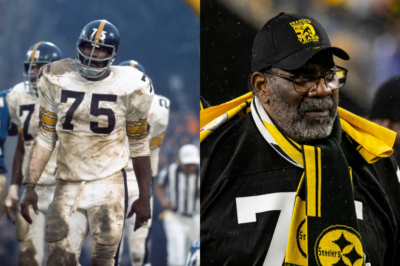
Confusion quickly spread across the football world after false reports surfaced about Mean Joe Greene — but the Pittsburgh Steelers legend is very much alive. Rumors claiming the 79-year-old Hall of Famer had passed away began circulating online, sparking concern among fans who remember Greene as one of the most dominant figures in NFL history. As messages of shock and tribute started appearing, it didn’t take long for clarification to emerge, shutting down the claims and confirming that the iconic defensive star is safe. Still, the incident highlights how quickly misinformation can spread — especially when it involves a beloved figure whose legacy spans generations. For many, it was a reminder of just how much Greene still means to the game and its fans. But one detail about how the rumor started is what’s now raising the most questions. And it may explain why so many believed it so quickly.
PITTSBURGH Steelers legend “Mean” Joe Greene has not died, despite a viral hoax circulating on social media. …
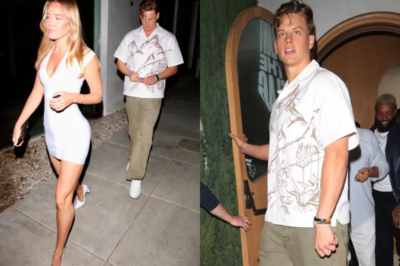
A post-Oscars night out has quickly turned into a trending topic after Joe Burrow was spotted alongside model Olivia Ponton. The Cincinnati Bengals star had already been part of a high-profile evening, attending celebrations linked to the Academy Awards alongside names like Alix Earle and Tate McRae. But it was what happened after the party that really caught fans’ attention. Burrow and Ponton were seen leaving together, sparking immediate speculation across social media about what the moment might mean. With cameras capturing the outing, the images quickly spread, fueling conversations that go far beyond a simple night out. Neither has publicly addressed the sighting, which has only added to the intrigue. But one small detail from the night is what fans keep coming back to. And it may reveal more than it seems at first glance.
Bengals quarterback Joe Burrow and model Olivia Ponton appear to be back on after the pair was spotted in Los…

New photos of Sarah Jane Ramos are quickly drawing attention following her high-profile split from Dak Prescott — and fans are already reading between the lines. The latest images show Ramos stepping out with a composed and confident presence, sparking a wave of reactions online as many point out the timing of her return to the spotlight. After what was described as a messy breakup, the sudden reappearance has only added to the intrigue surrounding what really happened behind the scenes. While neither side has fully detailed the split, speculation has continued to swirl, with followers closely analyzing every post and appearance. For some, the photos signal a fresh start. For others, they raise even more questions about how things unraveled so quickly. As the conversation grows, one subtle detail in the new images is what’s catching the most attention. And it might hint at where things truly stand now.
A smiling Sarah Jane Ramos resurfaced on social media Wednesday — less than two weeks after news of her messy split…

A heated reaction from Pat McAfee is adding fuel to an already controversial topic surrounding the National Football League. As discussions emerge about the possibility of replacement referees being used during the 2026 season, McAfee didn’t hold back — calling back to what he described as “terrible days” from past experiences with similar situations. For longtime fans, the mention of replacement officials immediately brings back memories of chaotic games, questionable calls, and widespread frustration across the league. Now, with the idea seemingly back on the table, concerns are quickly resurfacing about how it could impact the integrity of games at the highest level. McAfee’s blunt response has sparked debate among players and fans alike, with many wondering if the league is heading toward a familiar problem. But one detail about the current situation suggests this time might be different. And it could determine whether history repeats itself — or not.
PAT McAfee is slamming the NFL’s plans to use replacement referees. The 38-year-old former punter is recalling the last time…

An NFL career that once thrived on upsetting the odds has come to an unexpected end, as the player famously nicknamed “Giant Killer” has announced his abrupt retirement. Known for stepping up in big moments and delivering performances against top-tier opponents, the veteran built a reputation that made his nickname stick across the league. Over the years, he quietly accumulated more than $11.47 million in career earnings — a testament to both his longevity and impact. Yet despite still being seen as a valuable presence, the decision to walk away has come suddenly, leaving fans and analysts searching for answers. There had been little indication that retirement was imminent, making the timing all the more surprising. Now, attention is turning to what may have led to such a swift exit from the game. Because according to early whispers, one underlying factor may have played a much bigger role than anyone expected. And it could completely change how this decision is viewed.
AN NFL star nicknamed the ‘Giant Killer’ has announced his retirement abruptly. The Philadelphia Eagles icon sadly had a career between their…

A recent appearance by Jaxson Dart has unexpectedly gone viral — but not for anything that happened on the field. The New York Giants quarterback was spotted alongside his girlfriend in an outfit that quickly caught fans’ attention, sparking a wave of reactions across social media. While some praised his confidence, others couldn’t help but compare the look to something far more unexpected — with “pastor” jokes quickly taking over comment sections. Photos from the outing spread rapidly, turning what seemed like a normal moment into a trending topic among NFL fans. Dart, known for his competitive edge on the field, suddenly found himself at the center of a very different kind of spotlight — one driven entirely by style and perception. As the reactions continue to pour in, opinions remain split between admiration and amusement. But one specific detail about the outfit is what’s fueling the conversation most. And it’s the part fans can’t seem to agree on.
JAXSON Dart was roasted by fans online for his “pastor” outfit. The New York Giants quarterback has been enjoying the NFL offseason alongside girlfriend…
End of content
No more pages to load